

Google Calendar
Google LLC
I use Google Calendar as a practical control panel for appointments, deadlines, routines, and shared plans, rather than treating it as a simple list of reminders. It belongs in the productivity category, is made by Google LLC, and is free to use. After spending time with it, my impression is that its biggest strength is not visual excitement but the way it turns a busy schedule into something I can check quickly and adjust without much friction.
The app has a 4.7 average from around 4.6 million ratings, and it has passed 5 billion installs. Those figures match my general impression: this is a familiar, mature calendar aimed at ordinary daily planning, from a student tracking classes to a family coordinating appointments. It is rated for Everyone, so it is approachable for a broad audience, although the amount of information it can display may still feel overwhelming to someone who has never used a digital calendar.
How Google Calendar feels during everyday planning
The first thing I notice when opening it is how quickly I can move from “What do I have today?” to a useful answer. The day and week views are especially helpful when I need to understand the shape of my time instead of reading isolated reminders. A month view is better for spotting crowded periods, while a shorter view makes it easier to see where a meeting, errand, or focused work session actually fits.
Related News

Amazon Shopping App: Revolutionizing Your Mobile Shopping Experience

Google Assistant Shows How Mobile Productivity Is Changing

How Google Calendar is Transforming Mobile Productivity
That sense of speed is mostly about interaction rather than a stopwatch result. I can create an event, give it a clear title, choose a time, and save it without navigating through a complicated workflow. When I am in a hurry, this matters more than decorative animation. The app generally feels like it expects me to have somewhere else to be.
Its connection with the wider Google Workspace environment is also important. A calendar entry can sit alongside the rest of the digital routine many people already have, which reduces the need to maintain a separate planning system. I find this particularly useful when my work and personal commitments compete for the same hours. Instead of checking several unrelated lists, I can use one timeline as the starting point.
Related News

Why WhatsApp Messenger Still Makes Everyday Communication Feel Easy

Jurassic World: The Game Is the Better Dino Tycoon for Strategic Players

Threads in Real Life: Who Should Join, Lurk, or Leave

How SHEIN Turned Shopping Into an Endless Content Feed

How to Make Fortnite Feel Smarter on Mobile

Should You Switch to Microsoft Outlook on Mobile?
Still, speed depends on how much detail I try to add. A basic event is quick. A carefully organized event with a precise title, repeat pattern, guests, location, and reminders takes longer because each extra choice has to be considered. That is not a flaw in itself, but it creates a trade-off: the app is fast for capturing a commitment and slower when I want that commitment to carry a complete set of instructions.
A realistic weekday workflow
Imagine I have a medical appointment in the morning, a work call after lunch, and a school pickup later in the afternoon. I would first create the three events with names that explain the action, not just the place. “Doctor appointment” is more useful than “Clinic,” because the calendar should tell me what I am doing at a glance. I would then use different colors or calendars only if they genuinely improve recognition; too many visual categories can make the week harder to read.
Before the day begins, I can scan the schedule and identify the gaps. That is where the app becomes more than an electronic diary. I can see whether travel, preparation, or recovery time has been ignored. A common mistake is to fill every open space with another task. Google Calendar makes that mistake visible, but it does not automatically solve it for me. The quality of the result still depends on how honestly I estimate my time.
Gallery
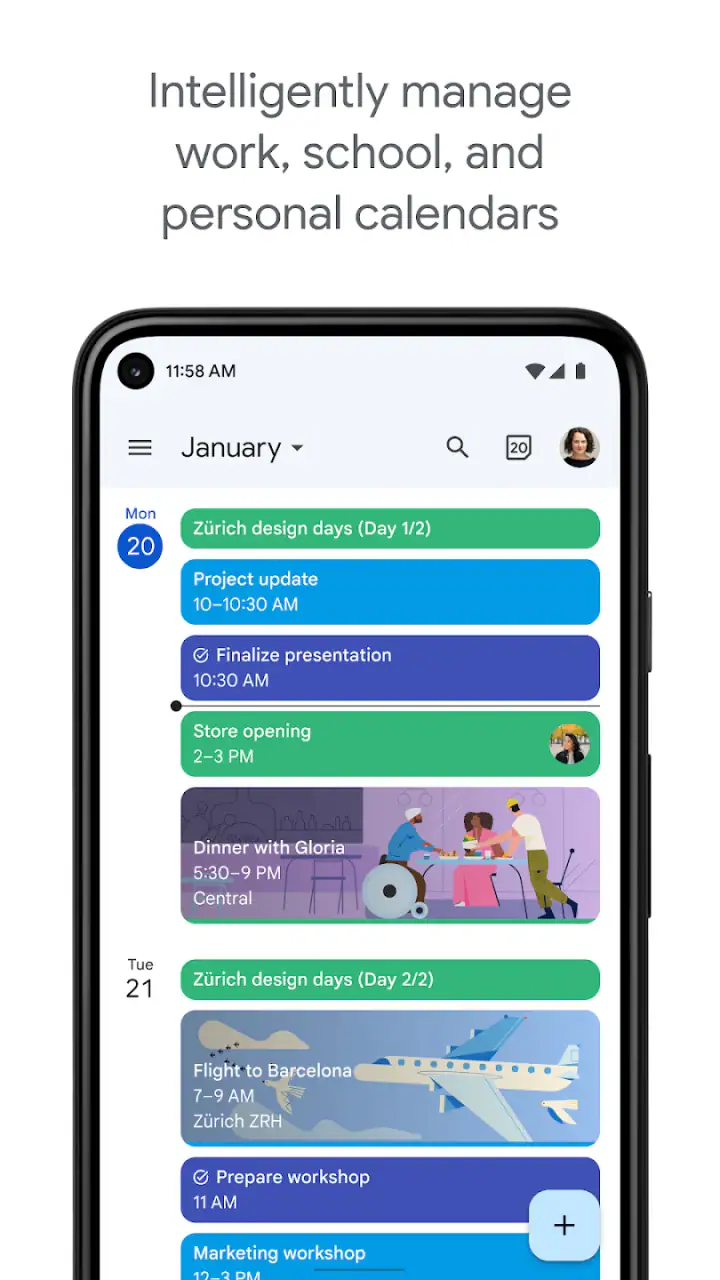
For recurring responsibilities, I prefer creating one properly defined repeating event instead of entering the same item manually every week. This reduces forgotten entries and makes later changes easier to manage. The important habit is to review the repeat settings before saving. A recurring event that continues longer than intended can quietly clutter future weeks, so I treat repeating schedules as something to check, not something to set and forget.
Where it remains responsive under heavier use
Google Calendar is most convincing when I have several calendars or a dense week to inspect. Switching between views helps me change perspective without rebuilding the schedule. I can look at a single day when precision matters, then step back to the month when I need to plan ahead. That makes heavy calendar use feel manageable because I am not forced to use one view for every decision.
The difficult moment comes when a schedule contains many overlapping events, recurring items, reminders, and shared commitments. At that point, the challenge is less about the app’s basic responsiveness and more about human attention. A screen full of colored blocks can technically contain everything I need while still making the important event difficult to notice. I have found that short titles and restrained color choices improve performance in the practical sense: I spend less time interpreting the screen.
Another useful habit is separating calendars by purpose only when the distinction changes what I do. Work, personal commitments, and family logistics can be sensible divisions. Creating a separate calendar for every minor project usually makes the interface noisier. This is a non-obvious strength of the app: it gives enough structure for detailed planning, but the best results come from using fewer categories than the interface might tempt me to create.
When I am planning a busy week, I also avoid putting every intention into the calendar. A fixed appointment deserves a firm place. A flexible task may be better represented with a realistic block or kept in a task list, depending on how I work. Treating the calendar as a promise rather than a storage box keeps it readable and helps me notice when I am overcommitting.
Reliability and recovering from mistakes
A calendar earns trust through consistency. I want to open it and understand what is happening without wondering whether an old event is still relevant or whether a change affected only one occurrence or an entire series. Google Calendar handles the ordinary rhythm of adding, editing, and reviewing events in a way that feels dependable for routine planning.
The most important reliability skill is learning to pause before editing a recurring event. When I change one instance, the app may need to distinguish that occurrence from the whole series. I read the choices carefully instead of tapping through them automatically. That small moment of attention prevents a local change, such as moving one appointment, from unexpectedly rewriting a pattern that I still need later.
I also recommend using event names that remain clear outside their original context. “Review” may make sense when I create it, but “Review quarterly budget” will still be meaningful weeks later. This improves recovery because, if I return to an old event to understand why it exists, the title gives me a useful clue. Calendar reliability is partly technical and partly editorial: the information I enter determines how recoverable my schedule is.
When plans change, I find it better to edit the original event than create a replacement and leave the old one behind. Duplicate entries are one of the easiest ways to lose confidence in any calendar. If I have invited other people or tied the event to a shared plan, I take extra care before changing it. The app can organize the information, but I remain responsible for checking that the updated schedule matches what everyone expects.
For important commitments, I use more than one reminder when the cost of forgetting is high, but I avoid turning every event into an alarm. Too many notifications train me to dismiss them. A practical approach is to reserve early reminders for events that require travel or preparation and use a closer reminder for simple appointments. This keeps the notification layer useful instead of noisy.
Device demands and practical limitations
Because Google Calendar is a mainstream productivity app rather than a visually intensive game, I do not approach it expecting dramatic hardware demands. My perceived experience is usually shaped by the number of events on screen, the complexity of the schedule, and the general condition of the device. A clean, simple calendar is naturally easier to scan than a crowded one, regardless of the phone being used.
On a device with limited screen space, the month view can become cramped, especially when several entries share a date. I prefer the agenda or day-oriented view when I need readable titles. This is not a reason to reject the app; it is a reminder that a calendar designed for broad use cannot make a small display behave like a desktop planner. People who manage a large professional schedule may prefer reviewing complex arrangements on a larger screen whenever possible.
Resource demands are also connected to how much information I ask the app to present. A few personal events create a lightweight experience. Numerous calendars, long histories, and dense recurring schedules create more visual and organizational load. I would not describe the app as difficult to use, but I would describe it as easy to clutter. The solution is regular maintenance: archive or hide calendars that no longer matter, remove obsolete repeating events, and keep titles concise.
Someone who wants a completely private, offline-first paper-like experience may not feel at home here. Google Calendar is most valuable when it fits into a connected digital routine and when the user is comfortable managing information through an account-based ecosystem. Someone who only needs a handful of occasional reminders may find it more elaborate than necessary and could be happier with a simpler reminder tool.
It is also not my first choice for project management. A calendar can show when a deadline or meeting occurs, but it does not replace a board for tracking many small tasks, dependencies, drafts, or ownership details. Likewise, people who need highly specialized scheduling rules may prefer a dedicated service built around their profession. Google Calendar is strongest as the shared time layer, not as a complete system for every kind of work.
Comparing it with simpler and specialized alternatives
Compared with a paper planner, the app wins when plans move frequently. I can adjust an event without rewriting a whole page, and recurring commitments do not need to be copied by hand. Paper still has advantages for free-form notes, visual creativity, and people who enjoy keeping their planning physically separate from their phone. My choice depends on whether flexibility or tactile simplicity matters more.
Compared with a basic reminder app, Google Calendar is better when timing and context are central. “Call the dentist” is a reminder; “Call the dentist during the available window before the appointment” belongs more naturally in a schedule. The calendar shows how commitments compete with one another, while a reminder list is often better for items that can happen at any convenient time.
Compared with a dedicated team planner, it is less suitable for detailed project coordination but often easier for ordinary appointments. A specialized tool may offer richer task status, assignment, and project views. Google Calendar feels less burdensome when the main question is simply, “When is everyone available?” That distinction helped me decide not to force every work activity into the same system.
Its relationship with Google Workspace is a major reason to choose it over an isolated calendar. If the rest of my routine already lives around Google services, the transition is familiar and the schedule feels connected to daily work. If I deliberately avoid that ecosystem or want an unusual planning philosophy, the app’s mainstream approach may feel restrictive rather than convenient.
Small practices that make a large difference
My strongest recommendation is to design events for the future version of yourself. Use specific titles, include the relevant place or context when it matters, and add preparation time when the appointment is not truly “instant.” This turns the calendar into a decision aid. A vague entry may technically reserve time, but a clear one reduces mental effort when the day becomes busy.
I also suggest a weekly review that looks for three things: events that no longer apply, repeating entries that need an end point, and days that are too full to be realistic. This is more valuable than repeatedly checking the calendar without changing anything. The review turns the app from a passive record into an active planning habit.
For shared plans, I keep the event title understandable to someone who did not create it. A family member should not need to know my private shorthand to understand the appointment. I also avoid placing sensitive detail in a title when a neutral description is enough. Clear information is useful, but unnecessary detail can make a shared calendar uncomfortable or confusing.
Another subtle workflow is using the month view for capacity and the day view for execution. I do not try to complete both jobs in one screen. The month view tells me whether a deadline-heavy period is approaching; the day view tells me what I should do next. Switching intentionally between those perspectives makes the app feel faster because each view has a specific purpose.
Who should use it and who should skip it
I recommend Google Calendar to people who regularly balance appointments, work meetings, family logistics, classes, or repeating routines. It is especially useful when plans change and when more than one person needs a shared understanding of timing. The free price removes an obvious barrier, and the Everyone age rating makes it a reasonable starting point for a wide range of users.
I would hesitate to recommend it to someone who wants only a minimal alarm list, dislikes account-centered digital tools, or prefers writing every plan by hand. I would also point project-heavy users toward a dedicated task or project system if they expect the calendar alone to manage detailed execution. The app can show the schedule, but it cannot make an unrealistic workload realistic.
After using it as both a daily agenda and a longer-range planning tool, I see its performance as steady in the way that matters most for this category: it gets me to my schedule quickly, remains useful when the week becomes crowded, and gives me practical ways to correct mistakes. Its main weakness is not a lack of capability but the ease with which a detailed calendar becomes visually noisy.
My final verdict is positive. Google Calendar is a dependable free productivity app for people who want one place to understand their time and adjust it as life changes. I would keep the setup simple, review recurring events carefully, and avoid treating every task as a fixed appointment. Used that way, it becomes less of a notification machine and more of a calm, readable map of the day.
FAQs for Google Calendar
What features does Google Calendar offer?
Google Calendar provides a variety of features to enhance your scheduling experience. It allows you to set reminders, schedule meetings, and create events with ease. You can integrate it with other Google services like Gmail and Google Meet, making it a comprehensive tool for both personal and professional use. Additionally, it supports multiple calendars and can be shared with others for collaborative planning.
Is Google Calendar available offline?
Yes, Google Calendar offers offline access, but with some limitations. You can view your events and check your daily schedule without an internet connection. However, creating or editing events requires being online. This feature is especially helpful for those who need to check their schedules while traveling or in areas with poor connectivity.
Can I sync Google Calendar with other calendars?
Google Calendar is highly compatible with other calendar applications. You can easily sync it with calendars like Apple Calendar and Microsoft Outlook. This ensures that all your events and appointments are consolidated in one place, preventing scheduling conflicts and keeping you organized across multiple platforms.
How secure is my information on Google Calendar?
Google Calendar employs robust security measures to protect your data. It uses encryption to safeguard your information and offers privacy settings to control who can view your calendar. Additionally, Google’s two-step verification adds an extra layer of security, ensuring that only authorized users can access your account.
Is Google Calendar free to use?
Google Calendar is free for individual users, providing access to its full suite of features. However, businesses may need to subscribe to Google Workspace for additional tools and enhanced support. The free version is sufficient for most personal and small business needs, while the paid version offers more comprehensive solutions for larger organizations.
Pros
- Seamless integration with other Google services.
- User-friendly interface for easy navigation.
- Customizable notifications and reminders.
- Supports multiple calendar views.
- Accessible offline for quick reference.
Cons
- Limited color coding options for events.
- Requires internet for full functionality.
- No advanced task management features.
- Event duplication can occur occasionally.
- Limited customization of recurring events.


